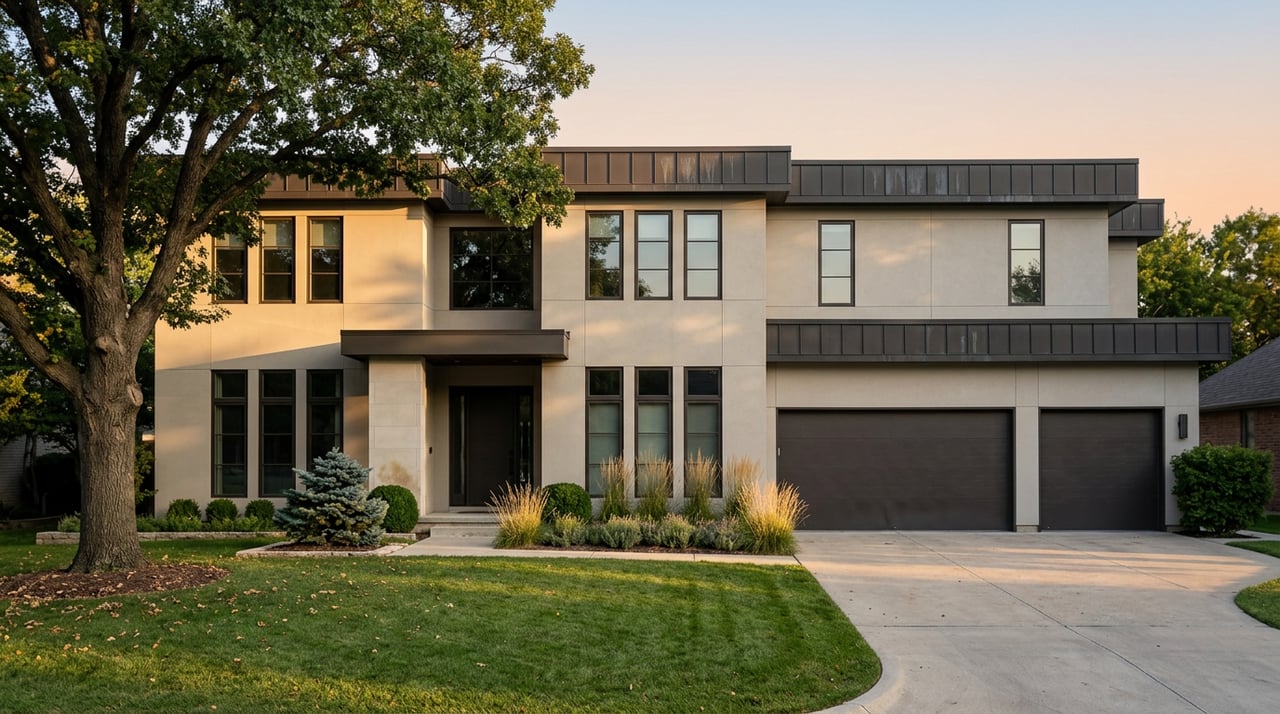
Drive a few blocks near the Greenwood Athletic Club and you will pass a 1978 split-level with the original siding, sitting on a lot that hasn't changed hands in decades, two doors down from a house finished last year that closed for well north of $3 million. Same street, same school boundary, same zip code. Different centuries of construction cost baked into the walls.
That contrast is not an anomaly in Greenwood Village right now. It is the market.
If you have spent any time this summer pulling up Greenwood Village numbers online, you have probably noticed they refuse to agree with each other. One live home-value tracker puts the average at $1.36 million as of this summer. A separate read of the market pegs the working median near $1.85 million for the second quarter of 2026. A third source lands near $1.4 million as of June 2026. A fourth, tracking only the trailing 30 days of closings, puts the median at $1.75 million. A fifth reports homes listed at a median of $1.48 million that same June. None of these sources are wrong. They are each taking a different bite out of a housing stock that no longer has a middle.
The land ran out first
Greenwood Village has some of the lowest residential density of any municipality in Arapahoe County outside Cherry Hills Village, by design. Larger parcels, generous setbacks, zoning built to protect the character of the streets. That was a feature for the families who bought in during the 1970s and 1980s. It has since become the constraint that defines everything happening in the market today, because there is very little vacant land left to build on.
When a city runs out of raw land, builders have exactly two ways to respond. They can buy an existing house and replace it, one lot at a time. Or they can find one of the very few remaining large parcels and build something entirely new on it. Greenwood Village is doing both, simultaneously, and the two strategies are producing wildly different products at wildly different price points inside the same city limits.
Response one: the scrape
The quieter of the two responses is happening lot by lot. Local builders are buying 1970s and 1980s ranch homes, particularly around the Greenwood Athletic Club area and along the east side of I-25 near the Villages at Castle Pines border, and replacing them with modern construction. New builds in this category run from roughly $1.2 million for a custom infill up to $4 million or more for a full teardown rebuild on a half-acre lot. Local estimates put teardown permits at 30 to 40 for 2026, up from roughly 25 the year before. Inventory of new construction sits tight at any given time, typically 15 to 25 active listings across the whole city.
The timeline on this path depends entirely on where you enter it. A spec home that a builder already has under construction can close in 30 to 45 days once it is finished or near finished. A true custom build, where you are choosing the lot and the architect is starting from a blank page, runs 18 to 30 months from closing on the land to moving in: 3 to 6 months of design, 1 to 2 months of permitting, and 12 to 18 months of construction.
Response two: the assembled parcel
The louder response broke ground this summer. Century Communities, itself headquartered in Greenwood Village, held a private groundbreaking on June 4, 2026 for The Village at Landmark, a gated community of 90 detached single-family homes on a 13-acre site directly south of The Landmark entertainment district. It is a rare enough event that the company called it one of the few opportunities of this size to come along in the city in years.
The homes range from 3,280 to 4,500 square feet, designed by Godden Sudik Architects, with private elevators, rooftop living space, and three-bay garages as standard features across two collections. Planned amenities include a central gathering space with fire pits and water features. Pricing is expected to fall between $1.7 million and $3 million. The community will sit walkable to The Landmark's shops, restaurants, and entertainment, and within easy reach of regional trails and Club Greenwood.
None of that will be available to buy for a while. Model home construction is expected to begin later in 2026, with home sales anticipated to start in spring 2027. That is a project that has been public for months and still will not put a single buyer on a closing date for the better part of a year.
"90 detached, luxury homes, each with rooftop living space, on a 13-acre site within walking distance of Landmark amenities represents a truly special combination of location, design, and livability," said Todd Baker, Regional President at Century Communities.
That is a builder's way of saying the site itself was the hard part. Assembling 13 contiguous acres in a city this land-constrained does not happen often, which is exactly why the last comparable opportunity is described that way.
Why your dashboard and your neighbor's dashboard disagree
Put those two responses next to each other and the price confusion stops being confusing. A market that is simultaneously producing $1.2 million infill spec homes, unrenovated original-owner ranch houses that have not been touched since the Reagan administration, $3.5 million to $4 million teardown rebuilds, and a forthcoming batch of $1.7 million to $3 million gated homes does not have a single center of gravity. It has several clusters, and which cluster a given data source happens to sample in a given month determines whether the headline number reads closer to $1.4 million or closer to $1.85 million.
This matters for a practical reason, not an academic one. If you are comparing a listing price to "the median" you saw somewhere online, you are very likely comparing it to the wrong slice of the market. The number that matters is not the citywide median. It is the median for your specific product type: original condition versus renovated, infill spec versus custom build, resale versus the new gated inventory that has not hit the market yet.
What this actually means if you are deciding right now
The honest version of the decision in front of a Greenwood Village buyer today is a timeline decision dressed up as a price decision.
- If speed matters most, a near-complete spec teardown is the fastest path to a move-in date, often 30 to 45 days from an executed contract, and you are buying a finished product rather than a set of choices.
- If control over design matters most, a custom infill build gives you that, at the cost of an 18 to 30 month runway and a land cost that is now a meaningful share of the total price in a city this constrained.
- If the walkable Landmark lifestyle and a low-maintenance gated setting matter most, The Village at Landmark is the only project of its kind currently in the pipeline, and it comes with a real wait: sales are not expected to open until spring 2027, with closings following after that.
None of these paths are wrong. They are simply not interchangeable, and a buyer who walks in comparing sticker prices across all three without accounting for the calendar attached to each one is comparing apples sitting on three different trees.
A few questions worth answering directly
Is Greenwood Village a buyer's market or a seller's market right now? The evidence points to neither extreme. A Q2 2026 read put average days on market near 38, and a spring 2026 report placed the range between 30 and 45 days depending on price tier, which describes a market that is competitive but not frantic. Pricing has held roughly flat to modestly up year over year depending on the segment measured.
Should I wait for The Village at Landmark instead of buying now? That depends on how much the specific product, a new gated home walkable to The Landmark, matters to you versus how much the wait matters. Spring 2027 is the earliest anticipated sales opening, and closings will follow after that, so anyone who needs to be settled before then has a real reason to look at existing inventory in parallel.
Why does the median price I found online not match the number I saw somewhere else? Because Greenwood Village's housing stock spans everything from untouched 1970s ranch homes to brand-new $3.5 million-plus rebuilds inside the same city limits, and each data source samples a different mix of that range at a different moment. Ask what a source's median is built from before you anchor to it.
Greenwood Village rewards buyers who read the mechanism behind the number, not just the number itself. If you are trying to figure out which of these three paths actually fits your timeline and your budget, The Galansky Group can walk through the current inventory, the teardown pipeline, and where The Village at Landmark sits in the process, and help you build a plan around the calendar rather than the headline. Request a Concierge Consultation to start that conversation.