"The original 1930 water decree for the property did not contain a water storage right to support the ponds." That sentence comes from a City of Greenwood Village project update about Marjorie Perry Nature Preserve. It explains most of what trail users have seen along the High Line Canal over the past two years, including the drilling pad, the trucks on the trail off Belleview Avenue, the new irrigation line beside the path and the young trees planted at intervals under the old cottonwoods.
The canopy over the canal grew on irrigation water. The trees planted to replace it will grow on groundwater pumped from a well more than 1,270 feet deep in the preserve. Between Belleview Avenue and the canal's second crossing of Orchard Road, where the first phase of irrigation was completed this spring, the trees along the canal now draw on two separate water supplies, and you can see both from the trail.
The old canopy grew on a canal that ran half the year
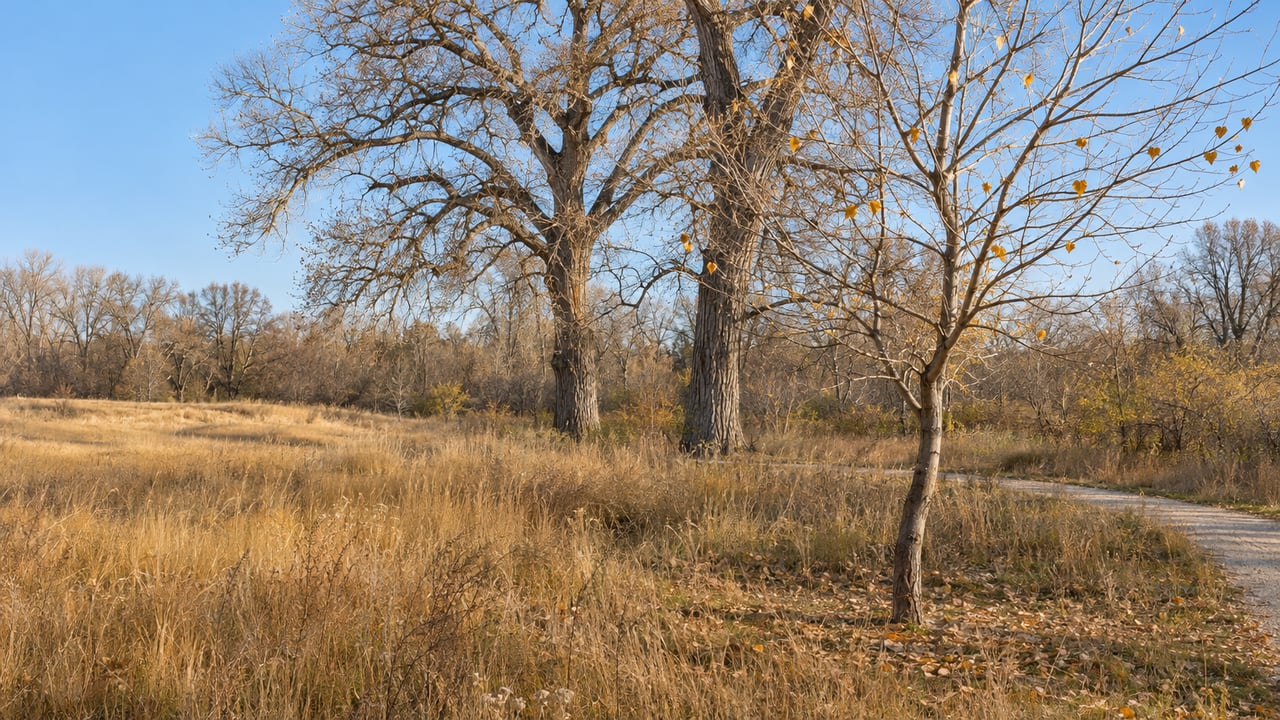
The High Line Canal was built to carry irrigation water, and its trees show it. The High Line Canal Conservancy says the canal used to be full for up to six months a year. Those frequent deliveries let a human-made channel act like a natural stream, and riparian trees moved in. Cottonwoods make up 43% of the canal's mature trees and willows another 8%.
That water schedule is gone. The Conservancy describes a canal in transition: Denver Water relies on it less for irrigation, and its main job is shifting toward green stormwater infrastructure. In June 2024, Denver Water announced it had transferred 45 miles of the canal to Arapahoe County, describing the corridor's future as a protected regional open space and trail. In the Conservancy's words, "With less water in the region and in the Canal, these trees are declining."
The trees were also getting old. The Conservancy's 2016 tree inventory counted 23,677 trees of 97 species along the corridor and found many cottonwoods nearing the end of a natural lifespan of roughly 70 to 120 years. Greenwood Village says many of the cottonwoods on its stretch are over 100 years old and need significant resources to maintain. Across the corridor, more than 1,000 unhealthy trees have been pruned or removed since 2018.
A tree that loses its water and also reaches old age needs a successor, and a successor planted in dry ground needs water. That is how a nature preserve ended up with a well.
Why the preserve needed to buy water
Marjorie Perry Nature Preserve covers 59 acres of wetlands and former farmland south of Belleview Avenue and west of Holly Street. The city acquired it in 1990, ponds included. The High Line Canal Trail runs almost all the way around it, and two conservation easements require the city to protect its scenic views, passive recreation and natural habitat.
The ponds are central to the preserve's wildlife habitat and scenery. The 1930 decree that came with the property gave them no storage right. In 2023 the city bought water rights to keep the ponds going and to irrigate the new trees it was planting along the trail. Owning those rights was only the first step. To use them, the city had to build a well, a well house and a distribution system.
So the same groundwater serves two purposes. It supports the ponds that give the preserve its character, and it waters the young trees that will become the canal's next canopy.
How the project was built
The city planned the project in steps, and each step changed what trail users saw.
| Step | What the city and Conservancy described | Timing as published |
|---|---|---|
| Tree plan | 250 new trees along the canal over five years, $360,000 total | Approved 2021 |
| Water rights | Purchased to sustain the ponds and irrigate new trees | 2023 |
| Well drilling | Hydro Resources drills past 1,270 feet, nonstop, behind noise walls | Scheduled March 24 to April 5, 2025 |
| Well house and pond distribution | A 15-by-17-foot well house with 8-foot walls, plus water lines to the ponds | The city's January 2026 newsletter scheduled construction to start in early 2026 and expected it to finish by the end of summer 2026 |
| Irrigation Phase 1 | Lines from Belleview Avenue to the canal's second crossing of Orchard Road | Completed spring 2026 |
| Irrigation Phase 2 | The remaining reach, from the second Orchard Road crossing to the first | Anticipated to begin fall 2026 |
A few details explain what trail users noticed. The drilling had to run 24 hours a day so the hole would not collapse, and the rig needed a pad 200 feet by 100 feet, a temporary access road off the canal and a staging area. The city committed to fully restoring those areas afterward. Contractors reached the site from Belleview Avenue along the trail itself, which is why trucks shared the path between Belleview and the well site. The well site was chosen because it already had an access road and heavy tree screening from the neighborhood next to it. The well was part of the city's 2024 Capital Improvement Program, budgeted at $1.9 million.
In its January 2026 newsletter, the city said the trail was expected to stay open for most of the well house and irrigation work, with only brief closures to let equipment pass safely.
What the new line replaces
The irrigation line takes over work that a water truck had been doing. Before the well, the city had to send a truck out to water the young trees, and the city said the new system would improve water access and reduce the costs of continuing to rely on watering trucks.
The city's planting pace also tracks a larger plan. The Conservancy's Plan for the High Line Canal recommends 3,500 new trees along the full 71-mile corridor over 15 years, about 50 per mile. Greenwood Village's plan of 250 trees over its 5.6 miles works out to about 45 per mile, close to the Conservancy's benchmark, and over five years instead of fifteen. For comparison, the Conservancy and its partners reported planting more than 450 trees across the whole corridor since 2019. At $360,000 for 250 trees, the city budgeted roughly $1,440 per tree, before the cost of the well that waters them.
Funding is shared. The Conservancy lists the irrigation project as paid for by Greenwood Village with support from Arapahoe County Open Spaces and the Conservancy. The city has said it will keep working with Arapahoe County and the Conservancy to maintain the canal's natural habitat.
The project fits a pattern of neighboring towns taking on their own pieces of the canal. Just south, at Mile 34 in Cherry Hills Village, the 1930s irrigation pond at Quincy Farm was dredged to make it smaller and deeper and to improve water quality and wildlife habitat. That dredging was completed in fall 2025 and planting followed in spring 2026.
Walking the stretch this season
Late fall, with the leaves down, is a good time to see the project. The Belleview-to-Orchard stretch around Marjorie Perry is where the first phase of irrigation went in.
- Getting in. The Conservancy suggests starting at the East Orchard Road trailhead and walking north, or starting at the Belleview trailhead and walking south. The canal trail loops around the open space.
- What you'll pass. The Conservancy describes the preserve as a place to see the ponds and the barn.
- Birds. The Conservancy notes that uncommon migratory birds pass over the preserve in fall.
- Hours. The Conservancy's trail guide lists the canal as open year-round from dawn to dusk, subject to changes by local recreation agencies, for walking, nature viewing, cycling, hiking, horseback riding and picnicking.
- Closures. The Conservancy posts closures and detours on its Trail Notices and Detours page.
North of the second Orchard Road crossing, the young trees along the path are now on the irrigation line. South of that crossing, toward the first Orchard Road crossing, is the Phase 2 reach the Conservancy listed as anticipated to begin this fall. The cottonwoods overhead belong to the period when the canal ran full half the year. The trees below them are watered from a source more than 1,270 feet down.
The young trees along the High Line Canal will shape that walk for generations, and they are one reason a home near the trail is worth something to its owner. If you live near the canal in Greenwood Village and are thinking about what your home is worth or what's next for it, The Galansky Group can walk through it with you. Request a Concierge Consultation.